


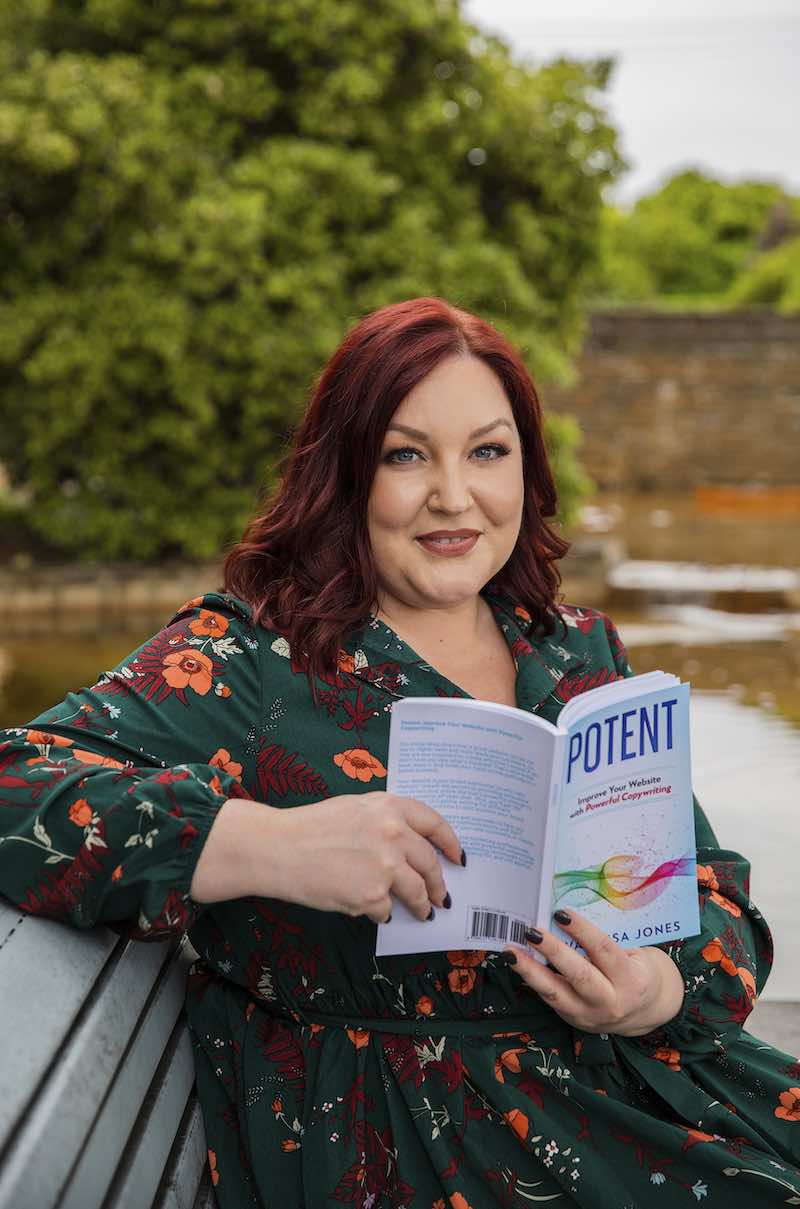
Vanessa Jones – freelance copywriter
SEO copywriter
Experienced freelance copywriter
I am a talented freelance copywriter, content strategist and number one bestselling author based in Adelaide with more than thirteen years of copywriting experience and a solid background in marketing.
I have worked with some of Australia’s most recognisable brands, including Mitsubishi Motors, Australian Institute of Business, TAFE, Southern Cross Care, Pinterest and more.
My clients know me as someone who doesn’t just write excellent and high-quality content but has a unique SEO skill set that helps people get the results they dream of. My unique ability to capture the perfect essence and tone will position your business at the forefront of your industry. With a powerful mix of marketing experience and exceptional writing skills, I’m your “go-to” copywriter for compelling copy.
Professional marketing copywriter
An impressive background
Before I jumped into freelance copywriting full-time in 2016, I worked for marketing agencies, not-for-profit organisations (including SA Great and SA Writers Centre) and even a beloved bookstore.
Not only am I an experienced and award-winning writer, but I have also worked as a marketing manager, a publicist/copywriter for marketing agencies, and a booked-out freelance copywriter. This means that I know the machinations of effective copywriting and how to make your assets or campaign shine even in a noisy market. And where they fit in your broader marketing strategy.
To back up my years of freelance copywriting experience, I’ve also studied professional writing, psychology, philosophy, creative writing and am a qualified yoga teacher. So, not only do I know a lot about copywriting, but I also know a lot about people!
Professional creative writer
Writing credits
As well as producing exceptional copywriting for clients, I am a professional creative writer. Here is a snapshot of my writing credits and achievements over the past few years.
Article published in Flying Solo, May 2017
Article published in WYZA, May 2017
Published my marketing book, Oct 2015
Article published in The Hoopla, Sept 2012
Article published in Southern Write, Sept 2012
Article published in Lip Magazine, June 2012
Article published in Southern Write, Sept 2011
National Year of Reading short story comp online audio recording, Sept 2011
Poem published in Independent Weekly, Dec 2007
Poem published in Independent Weekly, Aug 2007

Professional writing achievements
Runner up in Script Pipeline’s Great Movie and TV Idea contest, 2022
Shortlisted for Mercury CX Hothouse screenwriting residency, 2021
Mentor to TAFE SA writing students, 2016
Published author, 2015 to current
Winner of Hay House Australia Audition Competition, 2014
Panellist at 2013 Emerging Writers Festival in Melbourne
Qantas Spirit of Youth Awards commendation, 2013
Highly Commended, Creative Marketing, Australian Catalogue Awards, 2013 (for CitySA magazine)
Chair of SA Writers Centre Emerging Writers Forum, Jun 2012
SA Writers Centre Youth Ambassador and editorial member of Dubnium, 2011
Editor, Australian Poetry Anthology, 2011
Co-panellist of young writers at the SA Writers’ Festival, Sept 2011
Presented workshops at SA Writers Festival, 2011, Salisbury Writers Festival 2011 & 2012
Co-winner of Adult Learners Week, National Year of Reading short story comp, Sept 2011
‘Outstanding Achievement in Writing Poetry‘ at TAFE SA, 2010
Commendation for poem, Melbourne Poet’s Union International Poetry Comp, 2004

Check out my wide range of copywriting and marketing services
Here's what some of my clients have to say...
Meet my clients
Who I've worked with:
Need a terrific copywriter in Australia? Join the ranks of these well known brands and get expert copywriting today.


Five Prongs For Society
Here’s a little opinion piece I wrote for Lip Magazine. Tell me what you think. http://lipmag.com/opinion/five-prongs-for-society/
Ten copywriting tips
One of the most make or break things about professional copywriting is the structure and it absolutely pays to get it right. Structure is the order of ideas. More specifically, when it comes to professional copywriting services, it’s about looking at the way your assets are structured. Learning the fundamentals of structure are incredibly important so that you can apply it to your own writing and achieve successful results. Building block questions In every piece of copywriting, you need to look at the basic storytelling building block questions that are to be answered in the research phase. These answers to these fundamental questions will form the basis of the information of your piece of writing. Who? What? Where? When? Why? How? In addition to these building block questions, it pays to be clear on the following aspects of structure: tone (how you write something and how it comes across) point of view (first, second or third person) tense (past, present or future) active versus passive (subject, object and verb) sentence length (short and sharp or long and shiny?) Ten copywriting tips Referring back to what you learnt from identifying your target demographics, what will your different demographics want the most from your writing? Be sure to keep that top of mind or list three to six things when constructing your web article, media releases, editorial or social media posts and so on. Ensure you keep your reader hooked from the headline and all the way through the article to the call to action. Don’t get lazy at the end of your assets. Keep the writing sharp and concise through its entirety. Have a play around. You might find it easier to write an article, enewsletter or media release and stay on track if you write a headline before you write the body of the piece. It’s more effective to write in an active voice than passive voice. Passive voice shows uncertainty, often failing to influence or persuade others. It also creates wordiness, and often times lacks the clarity that the active voice provides. Stick to one idea per paragraph. Don’t forget to have a beginning, middle and end. Or an introduction and overview, bulk of the useful information and then a summary and conclusion. If a journalist only had room to print your first paragraph of a media release or article (without the heading or rest of the piece), would readers know the crucial details that they need? Make two lists: one of the most crucial points and the other list will be interesting facts, quirky ideas and stories that add flavour to your story/piece of writing. Think of the first list is your pasta and tomatoes and the second list as your herbs and spices, when making a delicious pasta dish! Remember that the most important information is not what you want to tell but what the readers want to know. If you loved these tips, you will love my copywriting book Perfect Your Content Articles

Using AI Writing Software ChatGPT for Blogging
GPT (Generative Pre-trained Transformer) is a language model developed by OpenAI that can generate human-like text. It has the ability to complete a given prompt or generate text based on a given topic or style. It can be used to assist with blogging by generating ideas for blog posts, providing suggestions for structure and organization, and even generating complete drafts of blog posts. To use GPT for blogging, you can provide it with a prompt or topic and have it generate text based on that prompt. For example, you might give it the prompt “Write a blog post about the benefits of meditation” and have it generate a list of ideas or a complete draft of a blog post on the topic. You can then edit and refine the generated text to suit your needs. It’s important to note that GPT is a tool and not a replacement for human writing and editing. While it can be a useful tool for generating ideas and providing inspiration, it’s important to review and revise the text it generates to ensure that it is accurate and meets the standards of your blog. What are the benefits of chatgpt for blogging? There are several benefits to using GPT for blogging: However, it’s important to note that GPT is a tool and not a replacement for human writing and editing. While it can be a useful tool for generating ideas and providing inspiration, it’s important to review and revise the text it generates to ensure that it is accurate and meets the standards of your blog. GPT (Generative Pre-trained Transformer) is a language model developed by OpenAI that can generate human-like text. It is best for tasks that involve generating text, such as: GPT can be used in a variety of contexts and industries, including content marketing, journalism, education, and more. It’s important to note that GPT is a tool and not a replacement for human writing and editing. While it can be a useful tool for generating ideas and providing inspiration, it’s important to review and revise the text it generates to ensure that it is accurate and meets the standards of your blog. What are the limitations of chatgpt for blogging? GPT (Generative Pre-trained Transformer) is a powerful language model that can generate human-like text, but it does have some limitations to consider when using it for blogging: It’s important to keep these limitations in mind when using GPT for blogging, and to review and revise the text it generates to ensure that it is accurate and meets the standards of your blog. You could use my preferred spellchecker, Grammarly, to help. Everything above was written by GPT and I left it unedited so you, as the reader, can get a sense of what it produces. Below, is entirely my copy without any assistance from AI. Why AI writing software doesn’t work for blogging Context is often missing. Humans can easily identify context and what information goes where. So you can’t rely on AI in terms of structure and what statements go where. I have used AI writing software in the past (I won’t mention which one for obvious reasons) and it just never suited my needs and I ended up getting frustrated with it. It’s an expensive software for me to keep flogging without the proper results of great quality content writing. It would repeat the same sentences over and over again. Literally, word for word. And then the next paragraph would say the same thing but with a few words different, liked they had been plucked out of a thesaurus and therefore, context was lost. Most AI, ChatGPT included do not even recognise that UK/Australian spelling exists (as you can see from the text above). Let alone language nuances and colloquialisms, which makes it tougher for the reader. Plus, the naturalness is removed. Often, I would discover by using Copyscape that the text wasn’t entirely original. And we know that when it comes to great writing, originality is key and is supposedly favoured by Google’s bots. Because I’m a fast and prolific writer, I have found that it’s just much quicker for me to write something from scratch than use AI software because by the time I have to edit the piece, I may as well have written it! Plus, you have feed the software prompts and plan out the structure yourself. Additionally, AI can’t insert correct facts, statistics, hyperlinks, quotes and research— a huge proponent of convincing articles and quality SEO blogs. Of course, it can’t help you with SEO factors that improve your search rankings such as formatting and keyword placement. And you can forget the personal anecdotes. As we know, ‘Personal experiences and anecdotes receive more respect, are perceived as more rational, and elicit a greater willingness to engage than facts and statistics.’ Are there any benefits to AI writing software? With the paid software that I used, they provided useful templates and copywriting formulas. These are really handy if you are new to copywriting. For example, it offers a PAS (pain, agitate, solve) template which helps the novice understand exactly how each of these facets function in a piece of writing. But, if you ask me, it’s cheaper to just watch some Youtube vids or buy a copywriting book. Interestingly, ChatGPT is poised as something that will be used IN PLACE OF Google search as the prediction is people will source a written paragraph on their query straight up. At the moment, ChatGPT is free whereas other AI writing software comes at a cost. Often, not cheap. And it will be surprising if it stays free forever. Plus, there’s the issue of copyright. Currently, it’s a very murky area and US copyright law might suggest hostility towards AI-generated content being attributed to humans. Australian copyright is a little different but, again, it is murky as law catches up to reality. What can you do instead? Practice writing. The more you practice, the quicker you will get at it and you’ll notice that software will actually slow you down rather than help. Wait. I’m sure one day AI writing software will get to a point where it is beyond helpful but it’s too new for that yet. Outsource. If you find that you’re bored of writing content, consider outsourcing to a freelance copywriter who lives and breathes writing (and SEO practices). Having a fresh take on your business’s content is always fruitful. Put it this way, I’m not fearing the downfall of my job or copywriting business anytime soon. Learn to write professional-level blog posts here. This post contains affiliate links of things that I actually believe in.